
5 Risk Management Mistakes That Kill Forex Accounts (And How to Fix Them)
You can have the best strategy in the world and still blow your account. It happens every day. Traders with real edge — solid entries, good reads on price action — watch their equity curve crater because of preventable risk management mistakes.
The uncomfortable truth is that most account blowups don't come from bad trades. They come from bad risk behavior around those trades. And the worst part? The same five mistakes show up over and over again.
This post breaks down each one, explains why it's so destructive, and gives you a concrete fix. If you want the full professional framework, read our complete guide on risk management for forex traders.
Mistake #1: No Fixed Risk Per Trade
This is the single most common mistake among developing traders: sizing positions based on gut feeling instead of a predefined percentage of account equity.
A trader sees a "high conviction" setup and loads up — maybe 5% of the account on a single trade. The next trade feels less certain, so they go with 0.5%. There's no consistency, no math, and no repeatable process.
The problem is asymmetric. One oversized loser can erase ten properly sized winners.
The Fix
Set a fixed risk per trade — typically 1% of account equity for developing traders, up to 2% for experienced professionals. Calculate your position size before every trade using: Position Size = (Account Balance x Risk %) / (Stop Loss in Pips x Pip Value)
No exceptions. For a deeper breakdown, see the position sizing section in our risk management guide.
Mistake #2: Moving Stop Losses
You enter a trade. You set a stop. The trade starts moving against you, so you move the stop. "Just a little more room." Then you move it again. This is how a 1% loss becomes a 5% loss.
Every time you move a stop, you are retroactively increasing your risk after the trade has already started going against you. It also makes your trading data meaningless.
The Fix
Treat the stop loss as locked the moment you enter the trade. The only acceptable stop adjustment is moving it in your favor — trailing your stop to lock in profit. Never widen. Ever.
Mistake #3: Ignoring Correlation
A trader risks 1% on EUR/USD long, 1% on GBP/USD long, and 1% on AUD/USD long. They think they have 3% risk across three independent trades. They actually have close to 3% risk on a single directional bet — USD weakness.
| Pair A | Pair B | Typical Correlation | Hidden Risk |
|---|---|---|---|
| EUR/USD | GBP/USD | +0.85 to +0.95 | Both are USD-short bets |
| AUD/USD | NZD/USD | +0.80 to +0.90 | Commodity bloc exposure |
| EUR/USD | USD/CHF | -0.85 to -0.95 | Long EUR/USD + Short USD/CHF = double the same trade |
The Fix
Treat correlated pairs as the same trade for risk purposes. If your max risk is 2% per "idea," and you're long EUR/USD at 1%, you only have 1% left for any other USD-short position.
Mistake #4: Revenge Trading After Losses
You take a loss. It stings. So you immediately jump back in — bigger size, less analysis, driven by the need to "make it back." This is revenge trading, and it is one of the fastest ways to destroy an account.
The Fix
Implement a mandatory cooling-off protocol:
- After 2 consecutive losses: Step away for 15 minutes.
- After hitting daily loss limit (2-3%): Stop trading for the day.
- After hitting weekly loss limit (5-6%): Reduce position sizes by 50% for the following week.
As we cover in our risk management framework, drawdown protocols are what separate traders who survive from traders who don't.
Mistake #5: Skipping the Trading Journal
If you don't journal your trades, you are flying blind. Without data on your own behavior, you have no way to identify which mistakes are costing you money.
What to Track
- Setup type — What triggered the entry?
- Planned vs. actual risk — Did you follow the plan?
- Emotional state — Calm, anxious, or revenge trading?
- Outcome and R-multiple
The Fix
Commit to journaling every trade for 30 days. The journal turns subjective feelings into objective data.
The Bottom Line
Fix these five mistakes and your equity curve changes — even without changing a single thing about your entries or exits.
For the full professional framework: Risk Management for Forex Traders.
Key Takeaways
- Risk 1% per trade with calculated position sizes — never size by feel
- Stop losses are locked at entry; the only adjustment is trailing in your favor
- Correlated pairs compound your exposure — treat them as a single risk event
- Revenge trading turns small losses into account-threatening drawdowns
- A trading journal turns gut feelings into actionable data
This post is part of our Risk Management series at Maverick Currencies.
Related Articles
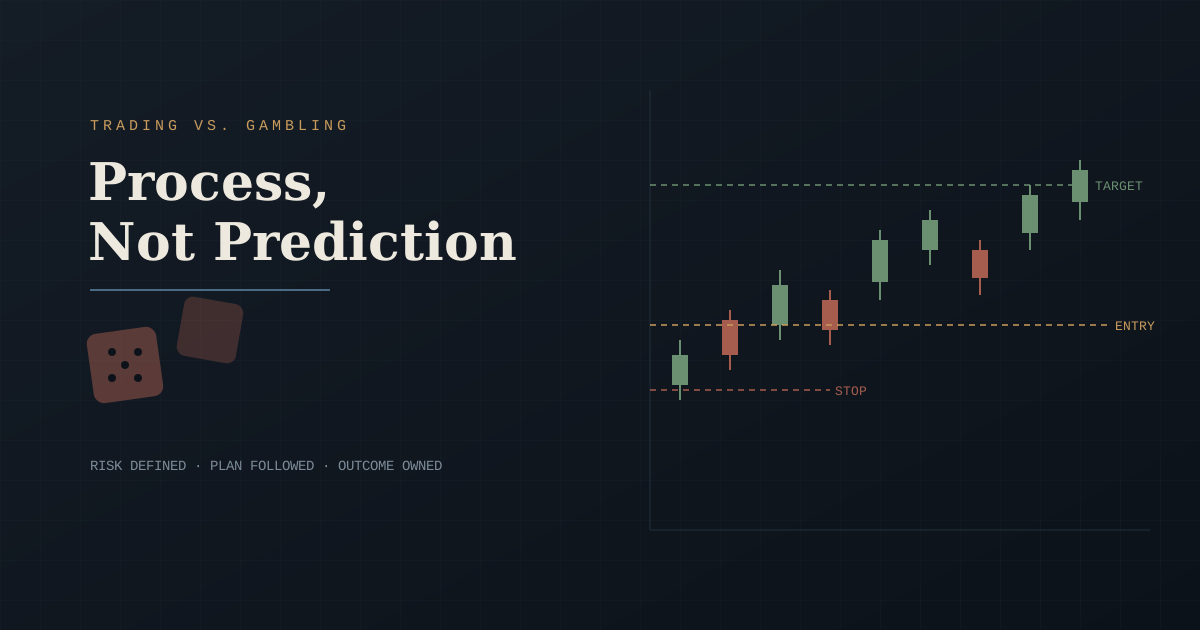
Trading vs. Gambling: What Actually Separates the Two
Trading and gambling both involve risk — but only one relies on a repeatable process. Here's what actually separates a trader from a gambler.
How Firms Manage Risk at Scale
Most traders think about risk in personal terms. But at the professional level, risk becomes a system-level challenge. Learn how firms manage exposure across markets, strategies, and traders to build consistent, long-term performance.
Position Sizing Calculator: How to Size Every Forex Trade Correctly
Position sizing is the mechanical bridge between your risk management plan and every trade you place. This guide breaks down the exact formula, worked examples for different account sizes, and the five most common sizing mistakes.