
At 9:55 a.m. New York time this past Thursday, the yen moved 2% against the dollar in a matter of minutes — a textbook case of trading currency intervention risk in real time. No data release. No scheduled headline. No warning. Traders who were flat-footed watched stop losses cascade in both directions as USD/JPY whipsawed on suspicion that Japan's Ministry of Finance had stepped back into the market to defend its currency.
By Friday morning, the Bank of Japan's policy decision and Governor Ueda's commentary were being parsed line by line for confirmation. The Ministry of Finance's intervention data, covering the days leading into the spike, was due out the same morning. Two catalysts, hours apart, both capable of moving the same pair another leg in either direction.
This is currency intervention risk in its purest form: sudden, opaque, and largely indifferent to your open position.
This is currency intervention risk in its purest form: sudden, opaque, and largely indifferent to your open position. It's also one of the most misunderstood risks in retail forex trading — treated either as an unpredictable act of God or, worse, ignored entirely until it wipes out a week of gains in one candle. Neither approach holds up. Intervention has a shape. It has warning signs, historical patterns, and a playbook for managing it. Here's what funded traders need to know.

What Currency Intervention Actually Is
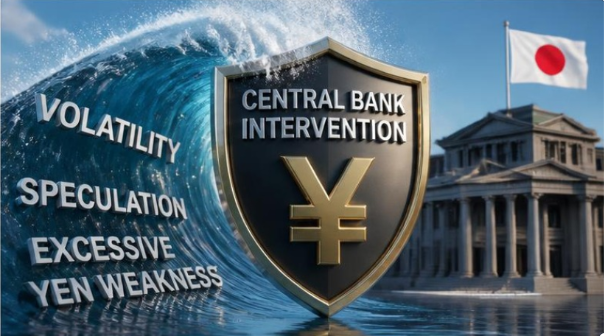
Currency intervention happens when a central bank or finance ministry buys or sells its own currency directly in the open market to push its value in a preferred direction, rather than relying solely on interest rate policy to do the work. Japan has the longest and most closely watched history of this among the major economies, largely because a weak yen has outsized effects on import costs and domestic inflation that Japanese policymakers are unwilling to tolerate past a certain threshold.
Verbal vs. Actual Intervention
Intervention comes in two flavors:
- Verbal intervention — officials talk the currency up or down through public statements, without actually transacting. This is cheap, frequent, and often has only a temporary effect.
- Actual intervention — the central bank or treasury physically buys or sells currency in size. This is rarer, more expensive, and typically reserved for moments when officials believe the market has moved too far, too fast, in a way that threatens broader economic stability.
The move traders saw Thursday has the fingerprints of actual intervention: a sharp, fast repricing with no news catalyst, concentrated in a single pair, at a time when USD/JPY had been grinding toward levels that have triggered Japanese intervention before.
Why Currency Intervention Is So Hard to Trade Around
Unlike a scheduled event such as a rate decision or an employment report, intervention doesn't appear on the economic calendar. Central banks intentionally avoid telegraphing the exact timing, because a known intervention window would simply invite traders to front-run it and blunt its effect. That unpredictability is the entire point — and it's exactly why so many retail accounts get caught leaning the wrong way.
Warning Signs That Intervention May Be Coming
What makes it manageable, though, is that intervention rarely comes out of nowhere. It tends to cluster around a few recognizable conditions:
- A currency pair has moved a long way, fast, in one direction — officials generally act to correct disorderly moves, not steady ones.
- The move has pushed through a level with historical significance — a price zone where intervention has happened before tends to draw renewed attention from policymakers.
- Verbal warnings have already started — a rise in public commentary from finance ministry or central bank officials about "excessive volatility" or "closely watching markets" is often the precursor to action, sometimes by days, sometimes by hours.
- The rate divergence story is stretched — intervention is far more likely when a currency's weakness is being driven by a wide and persistent gap between two countries' interest rate policies, which was very much the backdrop heading into this week's move.
None of these signs guarantee intervention is coming. But when several line up at once, as they did this week, the odds of a sudden two-way shock rise sharply — and that's the moment to adjust how you're positioned, not after the candle has already printed.
A Risk Framework for Intervention-Prone Conditions
You don't need to predict intervention to trade around it responsibly. You need a framework that keeps a surprise move from becoming an account-ending one.
You don't need to predict intervention to trade around it responsibly. You need a framework that keeps a surprise move from becoming an account-ending one.
Position Sizing and Stops
Size down before extremes, not after. If a pair is stretched toward a historically significant level and rate divergence is in the headlines, that's the moment to reduce position size — not the moment to average into a trend that "has to keep going."
Treat wide stops as information, not inconvenience. Intervention-driven spikes can blow through normal stop distances in seconds. If protecting a position properly requires a stop so wide it breaks your risk-per-trade rules, that's a signal to trade smaller or step aside, not to loosen the rules.
Execution and Trade Timing
Know your broker's execution during volatility spikes. Slippage during a 2% move in minutes is a real cost, not a hypothetical one. Understanding how orders fill during fast markets matters more than any indicator on your chart in these conditions.
Separate the spike from the trend. An intervention move often reverses part of itself once the immediate defense is complete, then resumes the underlying trend once the market re-establishes where fair value sits. Chasing the initial spike is a low-probability trade; waiting for the dust to settle usually isn't.
Intervention rarely arrives in isolation.
Respect the follow-through catalysts. Intervention rarely arrives in isolation. A central bank decision or an official data release covering the intervention period, landing within a day or two, can extend or completely unwind the initial move. Trading through that window with reduced size is often wiser than trying to trade the headline itself.
Why Currency Intervention Risk Matters More for Funded Traders
Volatility events like this are exactly where the structure of your trading account matters as much as your strategy. A trader operating with tight, arbitrary drawdown rules and no room to adjust position sizing on the fly is set up to get run over by a move like Thursday's — not because their analysis was wrong, but because their account structure didn't leave room to trade defensively.
At Maverick Currencies, funded traders aren't operating inside a rigid pass/fail challenge that punishes a single volatile session. Capital scales with performance over time, profit splits run 65–90% monthly, and support is built for traders working every session worldwide — not just the ones who happen to be awake when Tokyo opens. That structure exists precisely so a well-managed reaction to a moment like this week's yen spike gets rewarded, rather than a good trader getting knocked out by one unpredictable candle.
Markets will keep handing traders these moments. The difference between an account that survives them and one that doesn't usually comes down to preparation made well before the spike — not reaction after it.
Ready to trade with capital built for real market conditions? Apply to Maverick Currencies and find out if your risk management holds up where it counts.
Related Articles

Duration Disparity: Why You Sit in Losers Longer Than Winners
Duration disparity reveals why traders cut winners early and hold losers too long. Learn to measure it, fix it, and protect your edge.

The Personification Trap: Why Your Brain Treats the Market Like an Enemy
Discover the personification trap that makes traders see the market as an enemy—and learn how to break the revenge trading cycle for good.

Revenge Trading: When Loss Becomes Personal
Discover why revenge trading destroys trading accounts, the neuroscience behind it, and proven steps to break the cycle before your next trade.