
The 2:1 Asymmetry: How Loss Aversion in Trading Makes a Loss Hurt Twice as Much as a Win Feels Good
**The 2:1 Assymmetry: Loss Aversion in Trading
**
You're up 30 pips on EUR/USD. Your target is at 60. Your plan says hold. Your finger is already hovering over the close button.
You're down 20 pips on GBP/JPY. Your stop is at 25. Your plan says let it trigger. Your brain is already negotiating — maybe I'll give it 10 more pips. Support is right there. It'll come back. This is what loss aversion in trading looks like.
If both of these feel familiar, you're not undisciplined. You're not weak. You're running software that was installed 200,000 years ago — and that software has a bug that costs forex traders billions every year.
The bug has a name: loss aversion in trading, also known as the 2:1 asymmetry. And until you understand exactly how it works, you'll keep closing winners at +20 and holding losers to -60, wondering why your strategy works on paper but bleeds in practice.
Where Loss Aversion in Trading and the 2:1 Asymmetry Come From

In 1979, psychologists Daniel Kahneman and Amos Tversky published a paper that would eventually win a Nobel Prize in Economics. Prospect Theory demonstrated something that traders feel intuitively but rarely quantify: the pain of losing $100 is roughly twice as intense as the pleasure of gaining $100.
This isn't a personality flaw. It's evolutionary engineering.
Imagine two hunter-gatherers on the African savannah, 50,000 years ago. Hunter A treats gains and losses equally — finding extra berries feels exactly as good as losing berries feels bad. When the grass rustles, Hunter A calmly weighs probabilities and keeps gathering. Hunter B treats losses as twice as important as gains. When the grass rustles, Hunter B doesn't calculate. Hunter B runs. Every time.
Hunter A gets eaten. Hunter B survives and reproduces. Over thousands of generations, Hunter B's loss-averse brain becomes the standard human model. Fast forward to 2026, and you're Hunter B's descendant, sitting at a trading desk. Price moves against your position by 15 pips. Your brain doesn't see a 15-pip drawdown. It sees a lion. And it responds exactly the way evolution trained it to: by eliminating the threat, now, at any cost.
The 2:1 asymmetry kept your ancestors alive. It's keeping your trading account poor.
"The 2:1 asymmetry kept your ancestors alive. It's keeping your trading account poor."
How the Asymmetry Destroys Trades
The 2:1 asymmetry doesn't just create one kind of error. It produces four distinct patterns, each of which is lethal to long-term profitability.
Pattern 1: The Premature Exit
You're in profit. The trade is working. And instead of feeling calm, you feel anxious. Every pip in your favor increases the fear of giving it back. You close at +15 when the target is +40. You tell yourself "you can't go broke taking a profit." But you absolutely can go broke taking small profits and large losses — which is exactly what the 2:1 asymmetry produces over time.
Here's the math: if your average winner nets 20 pips and your average loser costs 50 pips, you need a win rate above 71% just to break even. Most strategies don't have win rates anywhere near that. A perfectly viable 45% win-rate strategy with a 1:2 risk-reward ratio becomes a losing system when the asymmetry shrinks your winners and inflates your losers.
Pattern 2: The Stop Negotiation
Price approaches your stop. You set it at -25 pips for a reason — a reason you calculated carefully before the trade was live.
But now that -25 is 5 pips away, your brain starts bargaining. It finds reasons the stop is wrong. Support is just below. The RSI is oversold. News is coming in 20 minutes that could reverse this. You widen the stop. Then widen it again. Then stop looking at the P&L entirely because the number is too painful to acknowledge.
This isn't analysis. It's your amygdala manufacturing excuses to avoid the pain of a realized loss. The unrealized loss doesn't feel as real as the realized one would — so you keep it unrealized, hoping the market will bail you out.
Pattern 3: The Revenge Trade
The stop gets hit. The loss is realized. The pain is acute — literally twice as intense as the pleasure of an equivalent win would have been.
Your brain, desperate to escape the pain, looks for the fastest possible relief. The fastest relief is another trade that wins — a dopamine hit to counteract the cortisol flood. So you take another trade. Not because it's a setup. Not because your plan says to. Because you need to feel better. And because you need to erase the loss quickly, you might even increase position size.
This isn't trading. It's an emotional feedback loop. And the market — indifferent to your internal state — will take your doubled position size and turn it into a doubled loss without hesitation.
Pattern 4: The Break-Even Obsession
You're down on the day. Not a catastrophic amount — just enough to sting. And now every decision is filtered through a single question: Will this trade get me back to flat?
You stop looking for good setups. You start looking for any setup that might erase the red. Criteria collapse. Position sizing creeps up. The goal shifts from executing your edge to escaping the discomfort of a red number. The break-even trader isn't greedy — they're trying to avoid the psychological pain of closing the platform down on the day. They'd rather gamble on a low-probability trade than sit with the discomfort of a loss.
The Double Hit: When Both Sides Fire at Once
The most destructive version of the 2:1 asymmetry happens when it hits on both sides of the same trading session.
You close a winner early at +30 because the fear of giving back gains is unbearable. The trade runs to +60 without you. Later that day, you hold a loser past your stop, past your pain threshold, past every rational exit signal — because the pain of realizing the loss is too intense. You finally capitulate at -80 on a trade that should have cost you 25.
Net result: +30 and -80. Down 50 pips on a day where following the plan would have produced +60 and -25 — a net gain of 35 pips.
The strategy didn't fail. The market didn't cheat. The 2:1 asymmetry inverted your entire risk-reward profile. Your plan was designed for 1:2. Your psychology executed it at roughly 1:2.5 — against you.
Why "Just Be More Disciplined" Doesn't Work
The standard advice is some version of "control your emotions" or "be more disciplined." This is well-meaning and completely useless.
The 2:1 asymmetry is not primarily a psychological problem. It's a physiological problem. When price moves against your position, your amygdala fires in milliseconds — faster than conscious thought. Cortisol floods your system. Your prefrontal cortex — the rational, planning part of your brain — partially goes offline. You literally cannot think your way out of the response in the moment because the thinking part of your brain is running at reduced capacity.
Telling a trader to "be more disciplined" while their amygdala is hijacking their brain is like telling someone to "just calm down" while they're drowning. The drive isn't psychological. It's biological. And biological problems require structural solutions.
Five Structural Fixes for the 2:1 Asymmetry
You can't delete the asymmetry. It's in your neurons. But you can build systems that function even when your ancient brain is screaming.
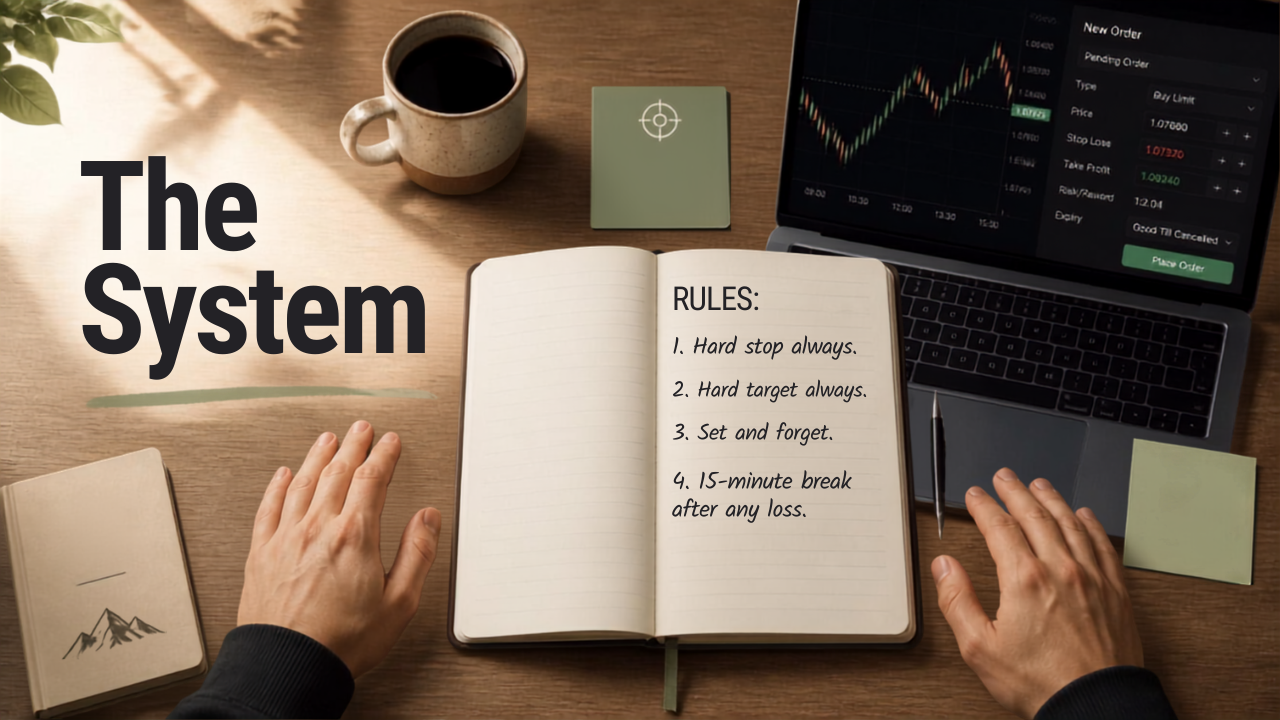
1. Hard Stops, Hard Targets, No Exceptions
Every trade gets a stop and a target entered into the platform before it goes live. Once it's in, you don't touch it. Not to widen. Not to close early. Not to "manage" the trade. The decisions were made when you were calm. The platform executes them automatically. Your amygdala gets no input.
A mental stop is not a stop. It's an intention. And intentions are worthless when your threat-response system is running the show.
"A mental stop is not a stop. It's an intention."
2. Trade Smaller
The louder the dollar amount at risk, the louder the asymmetry screams. If you find yourself interfering with trades — closing early, widening stops, revenge trading — cut your size in half. Trade at a level where the money is genuinely boring.
When the P&L doesn't trigger a survival response, you can execute cleanly. You can let winners run because you're not terrified of giving back gains. You can take stops without flinching because the loss doesn't feel like a predator attack.
3. The 15-Minute Circuit Breaker
After any losing trade — especially one that stings — close the platform for 15 minutes. No exceptions. No chart. No phone. No "just checking."
This isn't a timeout. It's a circuit breaker. It interrupts the neural loop that drives revenge trading and gives your prefrontal cortex time to come back online. The trade is over. The money is gone. The only question is whether you'll still have an account in 15 minutes.
4. Track Your Duration Disparity
Once a month, pull your trade data and calculate: average time in winning trades vs. average time in losing trades.
If your losers last longer than your winners, the 2:1 asymmetry is active in your trading — regardless of what your P&L says this month. Track this ratio over time. A declining number is genuine progress. A rising number is a warning that needs immediate attention.
5. De-Personalize the Loss
After every losing trade, say this out loud: "That was a cost of doing business. The trade is over. The next trade is independent."
The verbal component matters. Hearing yourself say it — not just think it — reinforces the neural pathway that treats losses as statistical events rather than personal failures. Over weeks and months, this simple practice reduces the emotional intensity of losses and shortens the recovery time between trades.
Losses are not failures. Losses are expenses. Every business has expenses. Trading is a business where the expenses are denominated in pips and the revenue comes from letting winners run. The 2:1 asymmetry flips that model upside down. These five fixes flip it back.
"Losses are not failures. Losses are expenses."
The Bottom Line
You are not broken. You are not undisciplined. You are a human being running ancient software that treats a 20-pip drawdown like a lion attack.
The 2:1 asymmetry is real. It's measurable. It's been demonstrated across thousands of studies and millions of trades. It is, without exaggeration, the single most well-documented psychological bias in financial decision-making. But it doesn't have to determine your outcomes.
The traders who win long-term aren't the ones who never feel the urge to close early or hold too long. They feel it every day. The difference is that they've accepted their biology, respected its power, and built systems that protect their capital from their own instincts.
Hard stops. Hard targets. Smaller size. Circuit breakers. Duration tracking. Loss de-personalization. None of this is complicated. All of it works. The question is whether you'll do it — consistently, mechanically, without negotiation — the next time you're up 30 pips and your finger is twitching over the close button.
Ready to Trade Beyond the Asymmetry?
Understanding the 2:1 trap is the first step. Building the systems that neutralize it is the real work — and you don't have to do it alone.
At Maverick Currencies, we've built a community of traders who understand that the edge isn't in the indicator — it's in the systems that protect you from your own biology. We provide the education, the frameworks, and the accountability structures that turn psychological insight into consistent execution.
👉Visit www.maverickcurrencies.com to learn more and join us today.
Disclaimer: This content is for informational and educational purposes only. It does not constitute financial advice. Trading foreign exchange, currencies, and other financial instruments involves substantial risk of loss and is not suitable for every investor. Past performance is not indicative of future results. Always consult with a qualified financial professional before making any trading decisions.
Related Articles

Duration Disparity: Why You Sit in Losers Longer Than Winners
Duration disparity reveals why traders cut winners early and hold losers too long. Learn to measure it, fix it, and protect your edge.

The Personification Trap: Why Your Brain Treats the Market Like an Enemy
Discover the personification trap that makes traders see the market as an enemy—and learn how to break the revenge trading cycle for good.
Revenge Trading: When Loss Becomes Personal
Discover why revenge trading destroys trading accounts, the neuroscience behind it, and proven steps to break the cycle before your next trade.